• FailUp Capital Research Team
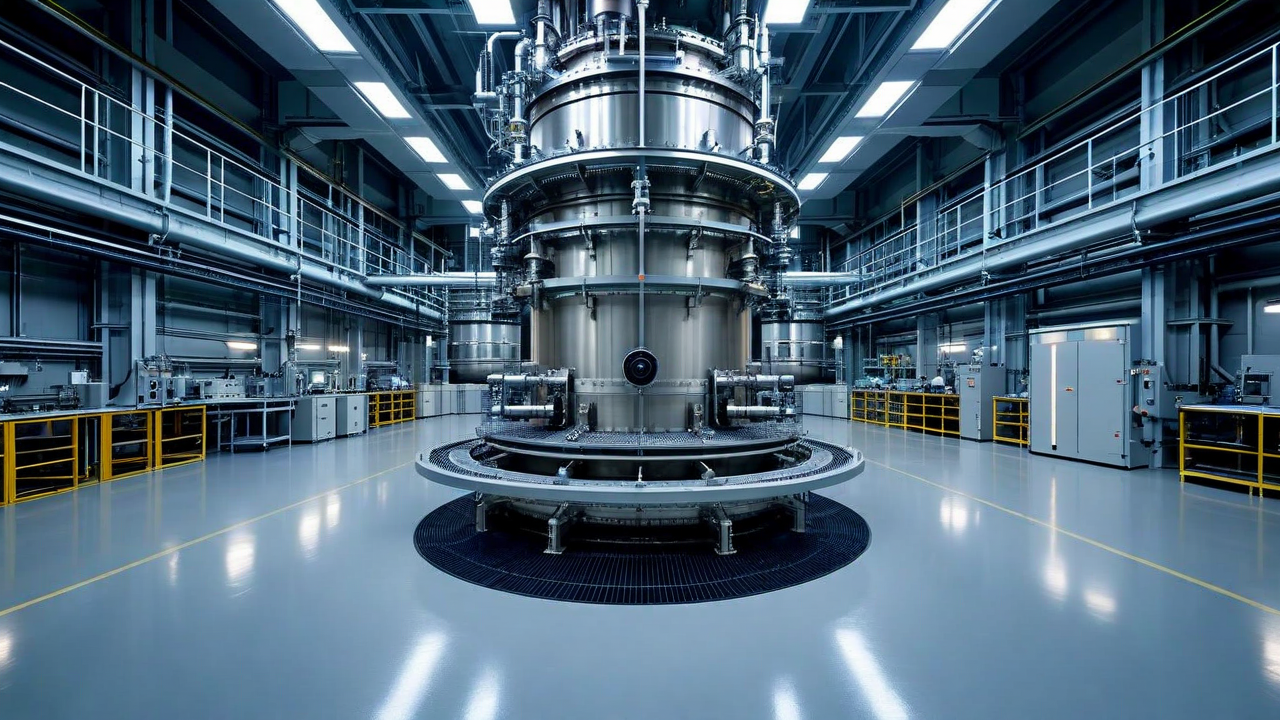
The joke about nuclear fusion has been the same for sixty years: it is always thirty years away. The joke is no longer funny, and it is no longer accurate. In the past decade, a combination of technical advances — most notably the development of high-temperature superconducting magnets with field strengths previously unachievable — and an unprecedented inflow of private venture capital have changed the trajectory of fusion development in ways that demand serious attention from the deep tech investment community.
Nuclear fusion is the process that powers the sun: the collision of light atomic nuclei at extreme temperatures to form heavier nuclei, releasing energy in the process. A fusion power plant burning deuterium and tritium — isotopes of hydrogen — would produce enormous amounts of energy from fuels that are either abundant (deuterium is extracted from seawater) or can be bred from lithium (tritium). The reaction produces no carbon dioxide and no long-lived radioactive waste. The fuel cannot sustain an uncontrolled chain reaction; if the plasma goes out, the reaction stops. It is, in principle, the cleanest and most abundant energy source conceivable.
The Physics of Progress
Achieving fusion requires heating plasma — ionized gas — to temperatures above 100 million degrees Celsius, ten times hotter than the core of the sun. At these temperatures, the kinetic energy of the nuclei is sufficient to overcome the electrostatic repulsion between their positive charges and allow nuclear fusion to occur. The challenge is confining a 100-million-degree plasma long enough and at high enough density for the energy it produces to exceed the energy input required to sustain it.
The most mature confinement concept is the tokamak — a toroidal (donut-shaped) chamber in which the plasma is confined by magnetic fields generated by superconducting coils surrounding the chamber. Tokamak research has been ongoing since the 1960s, with the main performance figure of merit being Q — the ratio of fusion power output to plasma heating power input. The international fusion research project ITER, currently under construction in France, is designed to achieve Q = 10, demonstrating ten times more energy out than in. It will be the largest scientific experiment in human history.
The breakthrough that changed the private fusion investment landscape is the development of high-temperature superconducting (HTS) tape, particularly rare-earth barium copper oxide (REBCO) conductors. REBCO tape can operate at much higher temperatures than conventional low-temperature superconductors, allowing the construction of much stronger magnets (fields above 20 Tesla) in more compact form factors. Stronger magnetic fields scale fusion performance dramatically: fusion power scales roughly as the fourth power of the magnetic field strength. A magnet twice as strong produces sixteen times the fusion power from a reactor of the same size.
The Private Fusion Landscape
The entry of private capital into fusion has accelerated remarkably in recent years. Where fusion was once exclusively the domain of large government programs with billion-dollar budgets and multi-decade timelines, private companies are now pursuing fusion with venture capital backing and timelines measured in years rather than decades.
Companies pursuing compact tokamak approaches using HTS magnets have attracted hundreds of millions of dollars from deep tech investors convinced that the HTS breakthrough changes the development timeline. The argument is that smaller, stronger magnets allow researchers to iterate through device designs much faster than the decade-scale timeline of large government tokamaks — running a new design in a year rather than a decade, learning from it quickly, and applying those lessons to the next iteration.
Alternative confinement concepts are also attracting investment. Inertial confinement fusion — compressing a pellet of fusion fuel to high density using laser or other driver pulses — achieved a historic milestone when the National Ignition Facility at Lawrence Livermore National Laboratory demonstrated fusion ignition in late 2022, producing more energy from the fusion reaction than the laser energy delivered to the target. Stellarators, field-reversed configurations, and magnetized target fusion approaches are all being pursued by private companies arguing that their specific confinement geometry has advantages over the dominant tokamak paradigm.
The Materials Challenge at the Heart of Fusion
Building a fusion power plant requires materials that do not yet exist in commercial form. The first wall of a fusion reactor — the surface directly exposed to the plasma — will be bombarded by high-energy neutrons and plasma particles, creating extreme heat loads and radiation damage. Conventional materials lose their structural integrity under this bombardment within years. Advanced materials capable of maintaining performance under fusion conditions — tungsten, reduced activation ferritic-martensitic steels, silicon carbide composites — are an active area of research that intersects directly with FailUp Capital's advanced materials investment thesis.
Superconducting magnet materials are equally critical. The HTS tape that enables compact high-field tokamaks must be manufactured at very high quality and very large quantities. The manufacturing of REBCO tape at the scale required for commercial fusion reactors is a significant industrial challenge. Companies developing improved processes for HTS tape manufacture are building businesses that serve the entire fusion industry, regardless of which specific confinement concept prevails.
The Investment Thesis for Fusion
Investing in fusion at the Seed stage is one of the highest-risk, potentially highest-reward bets in all of deep tech. The timeline to commercial electricity generation remains uncertain — the most optimistic credible estimates suggest pilot plants by the early 2030s, with commercial deployment later in the decade. The capital requirements are enormous; no fusion company will reach commercial scale without hundreds of millions or billions of dollars of additional capital beyond Seed funding.
For FailUp Capital, the most defensible fusion investments at the Seed stage are not bets on a specific company achieving fusion ignition by a specific date. They are investments in the enabling technologies that every fusion approach needs: HTS magnet manufacturing, plasma diagnostics, first-wall materials, tritium handling systems, and fusion plant balance-of-plant engineering. These enabling technology companies have nearer-term revenue opportunities serving the research fusion community and position themselves for massive scale-up if and when commercial fusion power becomes real.
Key Takeaways
- High-temperature superconducting magnet technology has changed the fusion development landscape, enabling compact, high-field devices that can iterate much faster than large government tokamaks.
- Private capital has entered fusion in a meaningful way, with multiple well-funded companies pursuing different confinement concepts on decade-scale commercial timelines.
- The National Ignition Facility's demonstration of fusion ignition in 2022 validated the scientific feasibility of fusion energy in a way that has increased investor confidence.
- Advanced materials — first-wall materials, HTS tape, plasma-facing components — are a critical enabling technology layer for fusion where investment opportunities exist independent of which confinement concept prevails.
- At the Seed stage, enabling technology suppliers offer more defensible positions than bets on specific confinement concepts achieving commercial scale on uncertain timelines.
Fusion and Nuclear Energy Founders
FailUp Capital is actively engaged with the fusion ecosystem. If you are building enabling technology for fusion or advanced nuclear energy, let us connect.
Talk to FailUp Capital