• FailUp Capital Research Team
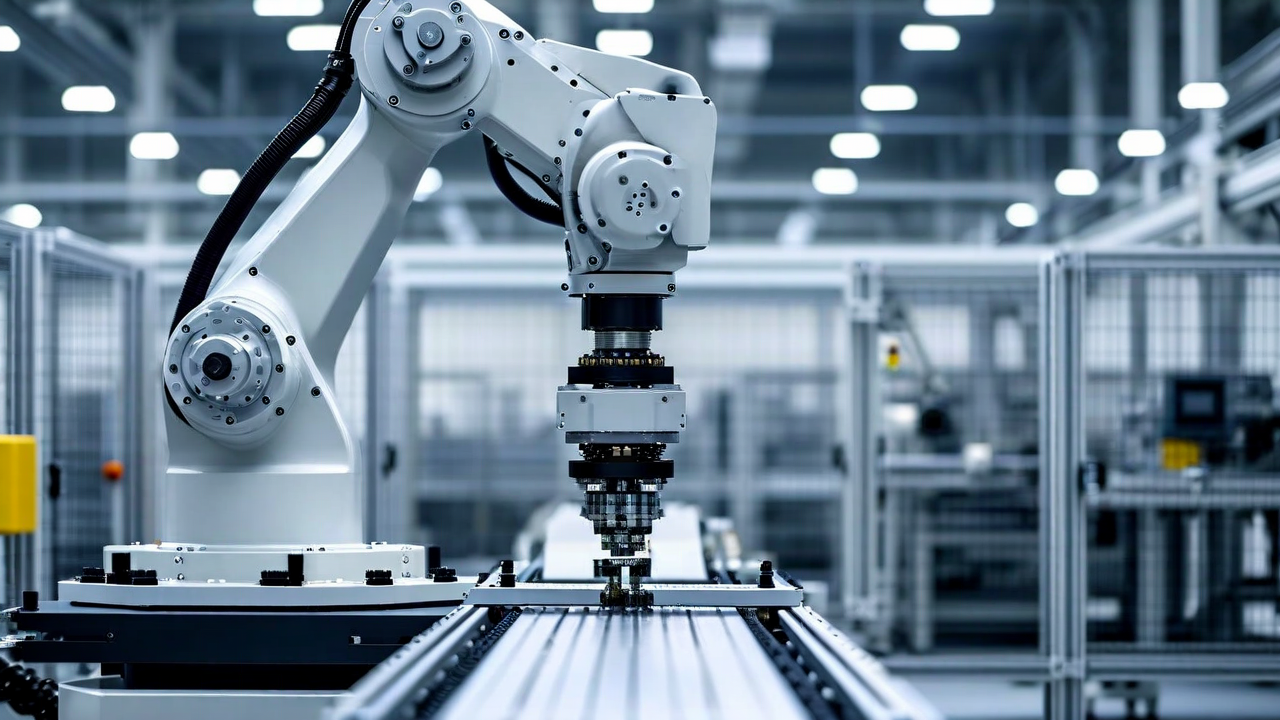
Industrial robots have been a fixture of manufacturing for fifty years. The welding robots that assemble automobile bodies, the paint robots that finish them, the pick-and-place robots that populate circuit boards — these are highly capable, deeply reliable, and extraordinarily limited. They operate in precisely controlled environments, performing the same motion over and over within tolerances measured in fractions of a millimeter. Remove them from their structured cages and their performance collapses. Ask them to handle an object they have not been explicitly programmed for, and they fail.
The next generation of robotics is different in kind, not just degree. Enabled by the convergence of machine learning, advanced sensing technologies, new actuator designs, and dramatically improved computing efficiency, a new class of robots is emerging that can perceive unstructured environments, adapt to novel objects and conditions, and operate safely alongside humans without elaborate physical barriers. These robots are not replacing the existing installed base of industrial automation — they are opening entirely new application categories that were previously inaccessible to automation at all.
The Unstructured Environment Problem
The fundamental challenge in robotics has always been perception and manipulation in unstructured environments. A traditional industrial robot operates in a tightly controlled workspace where every object has a known position, every motion is pre-programmed, and variability is eliminated through engineering of the environment rather than intelligence in the robot. This works beautifully in automobile assembly. It is completely inadequate in a warehouse receiving dock, a hospital supply room, a construction site, or a farm field.
In these real-world settings, objects come in arbitrary positions and orientations. Lighting conditions change. Novel items appear without warning. Human coworkers move through the workspace unpredictably. Addressing these challenges requires robots with genuine situational awareness — the ability to build a model of their environment in real time, reason about the objects and agents they encounter, plan manipulation strategies for arbitrary objects, and execute those strategies with hardware capable of delicate and forceful manipulation as the situation demands.
Machine learning has been transformative here, though not in the way many people initially expected. Early enthusiasm for end-to-end neural network control of robots — training networks directly from sensory input to motor commands — ran into the fundamental problem of data efficiency. Robots in the real world cannot collect the billions of training examples that large language models or image classifiers benefit from. The most successful approaches combine learned perception — where neural networks excel — with classical planning and control methods that are more data-efficient and more interpretable.
Soft Robotics and Novel Actuators
Traditional robots use rigid links and rotary or linear electric actuators. This mechanical architecture is excellent for precision and repeatability but produces machines that are inherently dangerous around soft, deformable objects — including humans. Handling a ripe tomato or a fragile medical device with a conventional rigid robot gripper requires extraordinary care and precision. One mistake means a crushed product or an injured worker.
Soft robotics takes a fundamentally different approach, building manipulators from flexible, compliant materials — often silicones, elastomers, and shape-memory polymers — that can deform to conform to the shape of objects they grasp. This inherent compliance makes soft robots naturally safe around humans and naturally gentle with fragile objects. It also makes them extraordinarily difficult to model mathematically, since the deformation behavior of soft materials is complex and highly nonlinear.
The development of useful soft robotic systems has required advances across multiple fronts simultaneously: new materials with better combinations of strength, flexibility, and durability; new actuator mechanisms including pneumatic, hydraulic, tendon-driven, and electrically-activated designs; new sensing approaches that can measure the configuration of a soft, deformable body; and new control algorithms that can operate effectively in the absence of a precise kinematic model.
Leading startups in soft robotics are making real progress on all of these fronts. The first commercial applications are in food handling, pharmaceutical manufacturing, and logistics — sectors where the gentleness and safety of soft manipulation translate directly into economic value. More capable soft robotic systems for surgical assistance, elder care, and unstructured manufacturing are in development.
Legged Robots and Mobile Manipulation
Wheels are excellent for locomotion on flat, prepared surfaces. They are poor for stairs, rubble, uneven terrain, and the vast majority of the built environment that was designed for bipedal humans, not wheeled machines. The development of capable legged robots — particularly quadrupeds and humanoid bipeds — has been one of the signature achievements of robotics research in the 2010s, and it is now transitioning from laboratory demonstration to commercial deployment.
Quadruped robots have found their first commercial niche in inspection applications: walking through industrial facilities, construction sites, and oil and gas infrastructure to collect sensor data and identify anomalies without requiring humans to enter hazardous environments. The combination of robust locomotion, multi-modal sensing, and autonomous navigation creates genuine value in settings where surveillance drones cannot reach and wheeled robots cannot maneuver.
Humanoid robots — bipedal machines roughly similar in size and form to a human — remain considerably more challenging. Bipedal locomotion is inherently less stable than quadrupedal gait, and manipulating objects with human-like dexterity while standing on two feet requires a level of whole-body coordination that is still at the frontier of research. Several companies are now developing commercial humanoids targeting specific industrial applications where the human form factor — the ability to use human tools, move through human-designed spaces, and interact with human workflows — provides a genuine advantage over purpose-built automation.
Autonomous Mobile Robots in Logistics
The logistics and warehousing sector has been an early and enthusiastic adopter of autonomous mobile robots (AMRs). The combination of relatively controlled environments, high labor costs, and straightforward performance metrics — items picked per hour, error rate, throughput — creates an ideal proving ground for robotic automation. AMRs navigating warehouse floors to fetch inventory, robotic arms picking items from shelves, and automated conveyor and sorting systems are all now operating at commercial scale.
The AMR market is growing rapidly, driven by e-commerce volumes that have increased dramatically during the pandemic period and by rising labor costs in distribution markets. But it is also becoming more competitive as the hardware and software components of basic AMR systems commoditize. The defensible positions in this market are shifting toward software — the warehouse management intelligence that optimizes multi-robot fleets, adapts to changing inventory profiles, and integrates with existing enterprise systems — and toward specialized hardware for the task-specific manipulation capabilities that remain genuinely difficult.
The Investment Thesis for Robotics Startups
Robotics startups present investors with a characteristic challenge: the system integration complexity is high, the hardware capital requirements are real, and the path from laboratory demonstration to commercial deployment involves multiple difficult engineering transitions. The companies that navigate this successfully typically share several characteristics: a focused initial application domain where performance requirements are well-defined and customers are willing to pay a premium; a software-forward architecture that allows the hardware platform to be a relatively stable foundation while the intelligence layer continues to improve; and a founding team that combines deep robotics engineering expertise with strong business development capability.
At FailUp Capital, we are particularly interested in robotics companies that are building systems for applications that have historically been resistant to automation — not the next iteration of an already-automated manufacturing process, but the first robotic system to operate effectively in a category that was previously human-only. These are the highest-value opportunities and the ones with the deepest competitive moats.
Key Takeaways
- The next generation of robots operates in unstructured environments using machine learning perception and adaptive manipulation — a fundamental departure from traditional programmed industrial automation.
- Soft robotics and novel actuator designs are enabling applications in food handling, pharmaceutical manufacturing, and healthcare that rigid robots cannot address.
- Legged robots are finding commercial niches in inspection, while humanoid platforms are approaching readiness for specific industrial applications.
- AMR deployment in logistics is growing rapidly, but defensible value is shifting toward software intelligence and specialized manipulation capability.
- The most compelling robotics investments target applications previously inaccessible to automation, with focused initial domains and software-forward architectures.
Robotics Founders
FailUp Capital invests in robotics companies solving genuinely hard problems. If you are building the next generation of capable machines, let us know.
Reach Out to FailUp Capital