• FailUp Capital Research Team
Few technologies generate as much investor excitement — and as much investor confusion — as quantum computing. Press releases announce historic milestones. Startup valuations reach hundreds of millions of dollars before a single commercial application has been demonstrated. Governments commit billions to national quantum programs. And deep in physics laboratories, researchers debate whether quantum advantage for practically useful problems is five years away or twenty-five.
For FailUp Capital, navigating the quantum computing landscape requires a discipline that is not common in the venture community: the willingness to say that something may be extraordinarily important and genuinely revolutionary, while also insisting on rigor about what is real today, what is likely in the next five years, and what remains speculative. This essay is our attempt to provide that grounding — to separate the legitimate signal from the considerable noise in quantum computing investment.
What Quantum Computers Actually Do
Classical computers process information as bits — binary digits that are either 0 or 1. Every operation a classical computer performs is built from operations on bits. Quantum computers use qubits — quantum bits that can exist in superpositions of 0 and 1 simultaneously. More importantly, multiple qubits can be entangled, creating correlations between their states that have no classical analogue. These quantum mechanical phenomena allow certain algorithms to solve certain problems exponentially faster than any classical algorithm.
The critical word in that last sentence is "certain." Quantum computers are not universally faster than classical computers. For most everyday computing tasks — loading a webpage, running a spreadsheet, playing a video — a quantum computer provides no advantage whatsoever. The exponential speedups that quantum algorithms provide are specific to a narrow but important class of problems: factoring large integers (relevant to breaking current cryptographic systems), simulating quantum mechanical systems (relevant to drug discovery and materials science), optimizing certain combinatorial problems, and performing specific linear algebra operations that underpin machine learning algorithms.
The Hardware Landscape: Five Competing Approaches
Unlike classical computing, which has been dominated by CMOS silicon transistors for sixty years, quantum computing has no established dominant hardware paradigm. Five distinct physical approaches are being actively pursued by companies and research institutions worldwide.
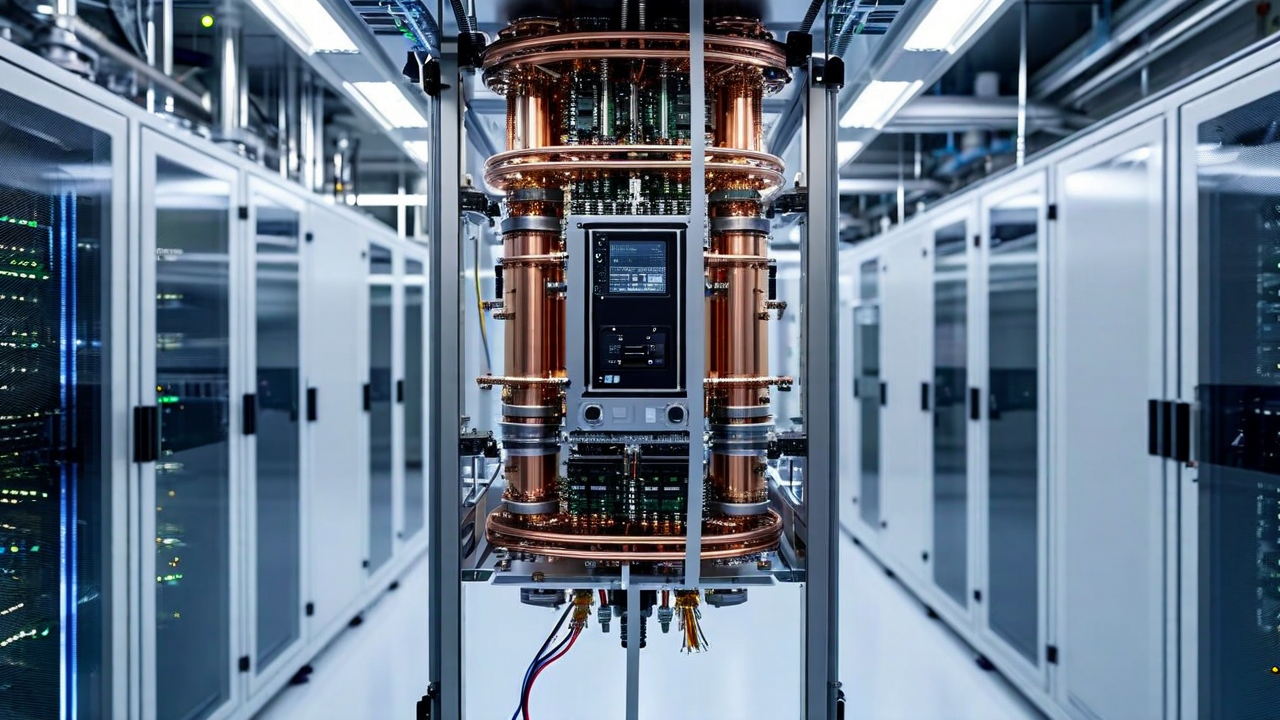
Superconducting qubits are currently the most advanced commercial platform. Companies and research labs use superconducting circuits cooled to temperatures near absolute zero to create qubits. The advantages are relatively fast gate times and compatibility with existing chip fabrication techniques. The disadvantages are the extreme cooling requirements — operating near 15 millikelvin demands dilution refrigerators — and relatively short Primewavence times that limit circuit depth before errors accumulate.
Trapped ion qubits use individual ions held in electromagnetic traps as qubits. Trapped ion systems have longer Primewavence times than current superconducting systems and can be physically moved to perform multi-qubit operations, enabling all-to-all connectivity. Their trade-off is slower gate times and challenges in scaling to large numbers of qubits while maintaining the precision needed for reliable operations.
Photonic qubits encode quantum information in photons — particles of light. Photonic systems operate at room temperature and are naturally suited to quantum communication applications. The challenge is creating the deterministic photon-photon interactions needed for quantum logic gates.
Neutral atom qubits trap individual neutral atoms in optical tweezers — tightly focused laser beams. Recent breakthroughs in Rydberg atom interactions have enabled impressive two-qubit gate fidelities, and neutral atom systems offer the potential for reconfigurable connectivity and scaling to hundreds of qubits in two-dimensional arrays.
Topological qubits are a theoretical approach in which quantum information is encoded in the topological properties of matter — anyon quasiparticles that are intrinsically protected from local perturbations. If topological qubits can be realized physically, they would be dramatically more robust against errors. Despite significant research investment, topological qubits remain in early-stage development.
The Error Problem: Why Fault Tolerance Is Decades Away
The fundamental challenge in quantum computing is error. Physical qubits are extraordinarily sensitive to environmental perturbations — stray electromagnetic fields, vibrations, thermal noise — and dePrimewave on timescales of microseconds to milliseconds. The error rates of current qubits are orders of magnitude too high to run the deep quantum circuits required for most applications of interest.
Quantum error correction addresses this by encoding a single logical qubit in many physical qubits, with redundancy that allows errors to be detected and corrected without destroying the quantum information. The challenge is that current error correction codes require thousands of physical qubits per logical qubit, and achieving the physical qubit quality necessary for error-corrected computation has not yet been demonstrated at scale. Estimates for when fault-tolerant quantum computers capable of running relevant algorithms will be available range from 2028 to 2035 and beyond, with significant uncertainty in both directions.
Near-Term Applications: Where Value Is Being Created Today
The honest picture of near-term quantum computing value creation does not involve exponential speedups on commercially relevant problems. Current noisy intermediate-scale quantum (NISQ) devices have tens to hundreds of physical qubits with high error rates, and their utility for practical computation is highly limited. However, there are genuine near-term opportunities that FailUp Capital finds interesting.
Quantum simulation — using a quantum computer to simulate quantum mechanical systems — is the application best suited to near-term devices. Quantum systems are inherently hard to simulate classically; even small molecules require classical compute resources that grow exponentially with molecular size. Quantum simulation of relevant molecules could accelerate drug discovery, materials science, and chemical process design in ways that would represent immediate commercial value.
Quantum sensing is a separate category entirely and represents some of the most commercially mature quantum technology. Quantum sensors — atomic clocks, magnetometers based on nitrogen-vacancy centers in diamond, gravimeters, and gyroscopes — use quantum mechanical effects to achieve sensing precision far beyond classical instruments. These are real products generating real revenue today, with applications in navigation, medical imaging, mineral exploration, and defense.
The Enabling Technology Investment Opportunity
One often-overlooked angle in quantum computing investment is the enabling technology layer. Building quantum computers requires extraordinary supporting infrastructure: dilution refrigerators, microwave electronics with sub-nanosecond precision, optical systems with single-photon sensitivity, cryogenic control electronics, and specialized software for compiling quantum circuits. Many of these enabling technologies have applications beyond quantum computing itself and represent investment opportunities with nearer-term revenue potential than pure quantum computing platforms.
Key Takeaways
- Quantum computers provide exponential speedups only for specific problem classes — not general-purpose computing acceleration.
- Five distinct hardware paradigms are competing, with superconducting and trapped-ion systems the most commercially advanced.
- Fault-tolerant quantum computation requires error correction overhead that will not be achievable at scale until the mid-to-late 2020s at the earliest.
- Near-term value lies in quantum simulation for molecular modeling and quantum sensing — which is generating commercial revenue today.
- Enabling technology suppliers (cryogenics, control electronics, classical simulation tools) represent nearer-term investment opportunities than quantum hardware itself.
Quantum Founders and Researchers
FailUp Capital engages with the full quantum ecosystem. If you are building enabling quantum technology or a near-term application, let us connect.
Talk to FailUp Capital